
Start the Dublin Resident Trail
Dublin is a city in eastern Alameda County, not a separate records jurisdiction. The City Clerk holds city material, while county offices keep the main property, recorded-document, court, vital, and election records. Match the first clue to the office that created it.
A name, street, parcel, or historical date leads to a different branch. An assessor result is an ownership lead, not proof of occupancy. A court case shows a party and event, not a present address. The Dublin residents directory works when separate clues are compared without treating one result as a complete household roll.
- Anchor the place. Use Alameda County Assessor Property Assessment Information with a standardized address or APN. Owner names use offline routes.
- Check voter status only for the voter. The California self-check is not a public by-name or by-street resident directory.
- Follow filed instruments. Search the recorder by party, instrument, date, or type, then treat the index as a pointer to the document.
- Choose corroboration. Court, vital, business, license, municipal, obituary, cemetery, and directory records answer narrower questions.
- Request what is missing. Name the custodian, series, address or APN, date range, and desired format.
The order matters. A parcel, case, or instrument number is stronger than a name alone. Historical work may require older place names and county sources because Dublin incorporated on February 1, 1982. Record what each result establishes and what remains open.
Where Dublin Keeps Resident Records
Most Dublin resident clues sit with Alameda County custodians. The Clerk-Recorder holds recorded documents and certificates, the Assessor maintains parcel data, the Registrar controls election data, and the Superior Court keeps case files. The City Clerk handles municipal records.
The bureau details show where a search changes hands. Access may be online, at a kiosk, by phone or email, at a counter, or through a focused request. A missing online name does not mean the record is absent.
Alameda County Clerk-Recorder
1106 Madison St.
Oakland, CA 94607
510-272-6362 / 888-280-7708
Official Public Records
Alameda County Assessor
1221 Oak St., Room 145
Oakland, CA
510-272-3787
Property Assessment Information
Alameda Registrar of Voters
1225 Fallon St., Room G-1
Oakland, CA 94612
510-272-6973 / 800-834-6454
Alameda Elections
Superior Court of California
County of Alameda
5151 Gleason Drive
Dublin, CA 94568
Online Court Services
Dublin City Hall is at 100 Civic Plaza. The City Clerk can be reached at 925-833-6650, Monday through Friday from 8:00 a.m. to 5:00 p.m. City records include Council actions, ordinances, disclosures, municipal files, and local-election material. Certificates go to Alameda County.
Search Dublin Resident Property Fields
The Alameda County property search is a parcel tool, not a current household list. Public fields can return an APN, address, values, exemptions, use code, maps, and recent transfers. Owner names are omitted online. Limited owner lookup uses phone, email, written request, or the free Oakland kiosk. The Dublin satellite is at 7600 Dublin Blvd., Suite 270.
Address and parcel searches use separate modes. Select the standardized autocomplete suggestion. Parcel numbers use dashes, such as 123-345-67, with no leading zeroes. Neither system offers a ZIP-wide search or public owner-name browse.
| Field | Control | Requirement | Format note |
|---|---|---|---|
| Parcel Number | Radio plus text | One search mode | Use a dashed APN such as 123-345-67 |
| Type Ahead Address | Radio plus autocomplete | One search mode | Select the standardized suggestion |
| Search | Button | Submit | Runs the selected mode |
| Reset | Button | Clear | Starts a new search |
The Dublin parcel GIS service adds the map side of the property trail. Its parcel service exposes APN, book, page, parcel, sub-parcel, situs and mailing address, latest document identifiers, values, building facts, and geometry. Owner names are not in that layer. Map exports are public data, not a legal survey.
Record terms. These words keep a property clue from being mistaken for a resident record.
- Roll
- An assessment list tracking parcels, values, exemptions, and tax details.
- Parcel
- A mapped land unit identified by an APN, not a household.
- Situs address
- The parcel’s physical location, distinct from a tax mailing address.
- Index
- A reference to a filed record, not the full instrument or image.
- Criss-cross directory
- An older reverse directory organized by address.
Dublin's 1969 Records Cutoff
Alameda County recorded documents reach back to 1853. The electronic index begins in 1969, while 1853 through 1968 requires an in-person search at 1106 Madison Street in Oakland. An early Dublin deed may be absent from a modern results screen even though the county still holds it.
The recorder search uses party names, instrument number, recording date, and document type, not street address or APN. Results can show Book/Page or instrument number, date, type, indexed and associated names, party roles, and row counts. Grantor and grantee roles matter. An index entry is a lead, not proof of current residence.
The Alameda County Official Public Records gateway explains the electronic cutoff and the office-based image rule.
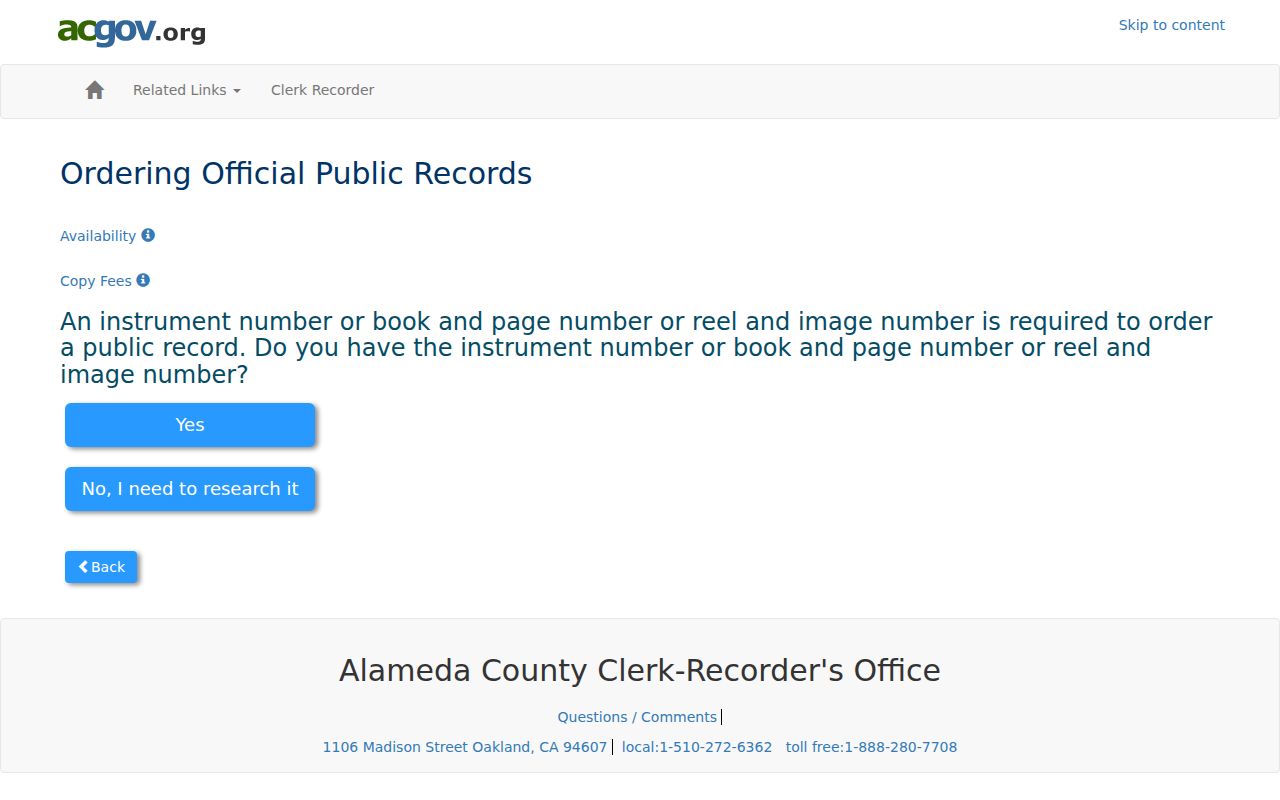
The free index narrows the instrument, but images are office-only under Government Code section 7928.215. Plain copies cost $3.50 per page. Certified copies cost $4.50 for the first page and $3.50 for each additional page. Mail requests generally take 5 to 10 business days.
Note: Allow about two weeks after a new filing before ordering, because a recent instrument may not yet be ready for copy service.
Dublin's Current Resident Rolls
A current Dublin residents directory is assembled from sources with different custodians. The table states what each source can show, rather than treating every name as a residence claim. Property, recorder, court, municipal, voter, business, and license records each have a defined route and limit.
| Current source | Useful evidence | Keeper | Access route |
|---|---|---|---|
| Assessor and tax parcel | APN, situs, mailing destination, values, exemptions, ownership lead | Alameda Assessor | Public parcel fields; owner by kiosk, phone, email, or request |
| Recorded-document index | Parties, instrument, date, document type, title trail | Alameda Clerk-Recorder | Free 1969-present index; earlier counter search |
| Dublin municipal records | Legislation, meetings, disclosures, permits, applications, licenses | City Clerk and departments | Laserfiche, CSS, NextRequest, or office request |
| Superior Court access | Case number, parties, type, filing date, register events | Alameda Superior Court | eCourt, Odyssey, DomainWeb, counter, or record request |
| My Voter Status | A voter’s own registration status, districts, and election details | California Secretary of State | Authenticated self-check; controlled file is separate |
| Business and license records | Entity, agent, filed address, license status, discipline | California SOS and DCA | Free public searches; affiliation is not residence |
A name-first search can mislead. An entity agent may be a service address, a tax mailing address may be away from the parcel, and a court party may be a witness or litigant. For street work, the Dublin street directory follows the address chain.
Use a second source to test identity, keeping spelling, date, APN, instrument, case number, and party role together.
Dublin Voter Lookup Limits
California My Voter Status is an identity-checked self-service tool. A voter enters a name, date of birth, and the sensitive identifier requested by the form. A match can return registration status, party preference, vote-by-mail status, polling place, and election details. It is not an open name search for Dublin residents.
California Elections Code section 2194 limits voter data to election, scholarly, journalistic, political, governmental, or record-review purposes. Government Code section 7924.000 protects sensitive fields and confidential voters. The state’s voter privacy explanation describes the boundary. A request for everyone on a Dublin street is not a specific-voter request.
Privacy boundary. Voter data cannot lawfully become an unrestricted Dublin residents directory. Use the self-check for the person checking their own status, and respect confidential registration and Safe at Home protections.
Safe at Home participants can receive a substitute mailing address, confidential voter registration, confidential name-change handling, and certain DMV protections. The program is reached at 877-322-5227. A protected result is an intentional endpoint.
Note: Voter status confirms the registrant's details, not property ownership, occupancy, or a complete address history for everyone at the location.
Dublin City Record Portals
The Dublin City Clerk at 100 Civic Plaza handles Council actions, ordinances, disclosures, legal documents, local-election files, and CPRA coordination. Laserfiche WebLink browses or searches legislation, agendas, minutes, resolutions, and disclosures. Dublin NextRequest handles focused municipal requests.
Dublin launched Tyler/EnerGov Citizen Self-Service on July 5, 2024. CSS covers building and public-works permits, planning, fire permits, and business licenses, including payments, inspections, and document exchange. Application management requires an account; exact anonymous fields were gated.
City GIS adds address, parcel, school, park, street, land-use, zoning, and service layers. A parcel report gives context, not a public resident roll. A permit applicant, developer, contractor, or disclosure filer should not be recast as the person living at an address.
Note: A CSS no-result may reflect the July 2024 system cutover, so older permit material may require a City Clerk request.
Dublin's Historical Directory Trail
Historical Dublin resident directories change names as the community changes. The 1894 Husted’s Oakland, Alameda and Berkeley Directory gives Dublin its own heading and calls it Dougherty Station. Entries show names, occupations, trades, businesses, offices, or locality, but may lack street numbers, spouses, telephones, or occupancy marks.
Earlier volumes list Murray Township. The inventory identifies 1870 and 1876 county volumes plus later runs through 1969. “Alameda County directory” does not guarantee Dublin coverage, so check each issue with Dougherty Station, Murray Township, and family names.
The Dublin Library local-history collection offers local books, newspaper clippings, and the digitized Heritage Park photograph project.
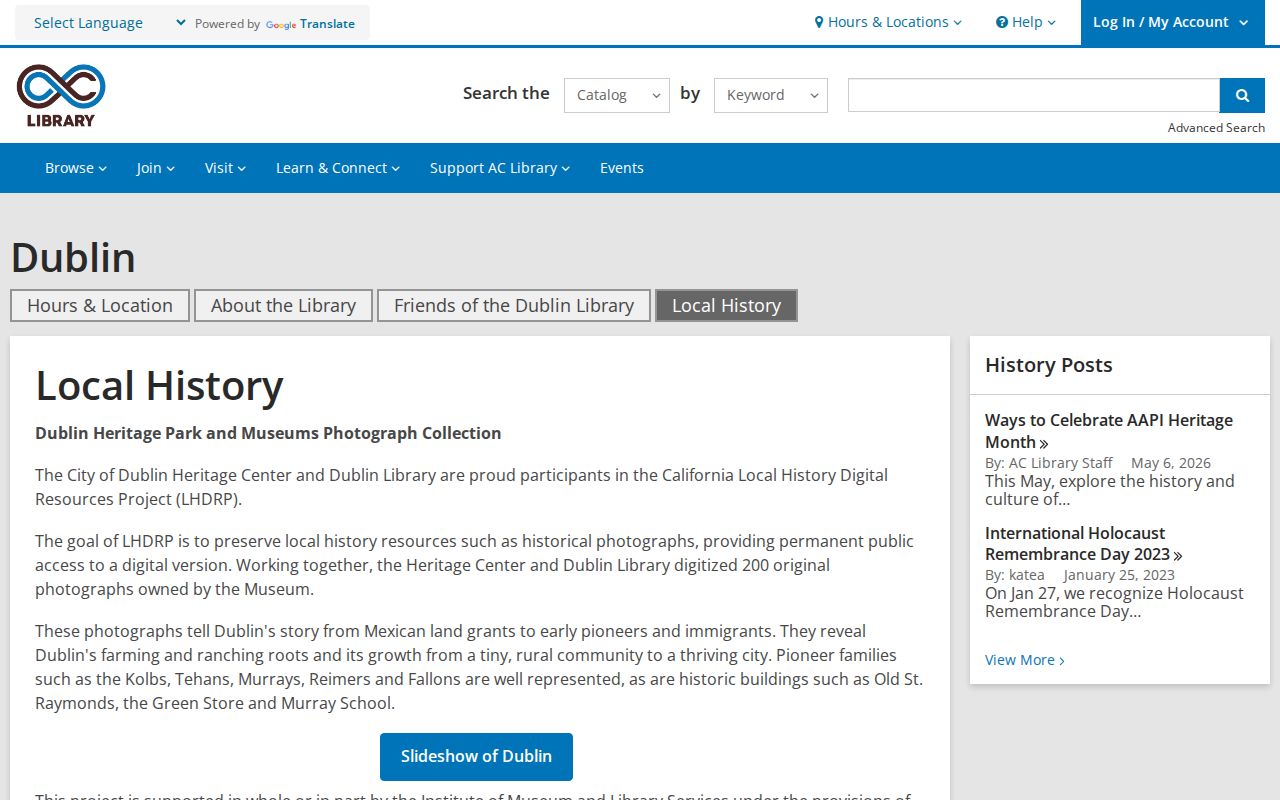
The address-first Haines East Bay and Southern Alameda criss-cross runs cover 1973-1982 and 1984-2019 at the Oakland History Center. Verify Dublin coverage in each telephone issue. The Dublin city directory page keeps collection details separate from current parcel work.
Dublin Pioneer Cemetery at 6600 Donlon Way has more than 600 memorial locations and a virtual explorer, creating a local name-to-place clue without proving a current household.
Dublin Before Incorporation
A modern Dublin search reaches into Rancho San Ramon, Dougherty Station, and Murray Township references. Dublin remained unincorporated until voters approved incorporation in 1981, and the city began on February 1, 1982. County deeds, census schedules, newspapers, cemetery material, and family names carry much of the early trail.
Boundaries create handoffs. Camp Parks entered the city in 1986, western additions continued through 1991, and eastern growth began in 1995. During World War II, Fleet City housed about 90,000 sailors and Marines, with more than 350,000 personnel passing through or working at the bases. Federal sources may document people absent from ordinary directories.
Dublin’s dedicated ZIP Code 94568 also dates to 1982. Postal, planning, federal, and incorporated-city boundaries can differ, so test an old address with the parcel layer and the relevant custodian.
Dublin Business and License Records
Affiliation records can distinguish similar names when a parcel, occupation, or organization is known. The California Secretary of State bizfile Business Search is free without an account. Keyword or contains searches cap closest matches at 500. Results may show entity number, formation, status, jurisdiction, street and mailing addresses, agent, and filed officers or managers.
The business search is a Dublin residents directory clue, not a residence record. An agent is not automatically an owner or occupant, and the Secretary of State does not generally record beneficial ownership, phone, email, or every relationship. Plain PDFs are free; an account handles filings and certified orders.
The California business-search gateway shows the entity fields that can be compared with a Dublin name or address.
The result is strongest when entity number, formation date, filing address, and named role line up with an independent Dublin record.
Dublin Resident Sources Compared
Official custodians and commercial data compilations are not interchangeable. An official result has a named keeper, record purpose, and correction, sealing, or copy route. A compilation may combine public, licensed, and inferred data. The comparison keeps that distinction visible.
| Question | Official custodian | Commercial compilation |
|---|---|---|
| Where did the result come from? | A county, city, court, state office, library, or named archive | A combined data feed with mixed source dates and methods |
| What does the result establish? | Only the fields and event covered by that record series | A lead that may be inferred, stale, incomplete, or merged |
| How is an error handled? | Ask the custodian about correction, sealing, redaction, or a certified copy | Use the provider’s correction or removal process, then verify at the source |
| What happens to protected data? | Confidential, sealed, or restricted fields stay out of the public route | Coverage and suppression depend on the compilation’s sources and update cycle |
| What is the next best step? | Record the case, APN, instrument, date, or document number and contact the keeper | Do not let a combined profile override the official custodian |
For Dublin family history, reconnecting, civic research, property curiosity, or scam avoidance, the official path is slower but clearer. A free index may lead to a paid copy, office-only image, terminal, or request, without changing what the record proves.
Dublin Court and Vital Records
Dublin cases are handled by the Superior Court of California, County of Alameda. Online services separate civil eCourt, criminal Odyssey, and probate routes associated with DomainWeb. The East County Hall of Justice is at 5151 Gleason Drive. A case number is stronger than a party name; public fields include parties, case type, filing date, calendar details, and register events.
The Alameda Superior Court online-services gateway shows the separate paths for civil and criminal access.
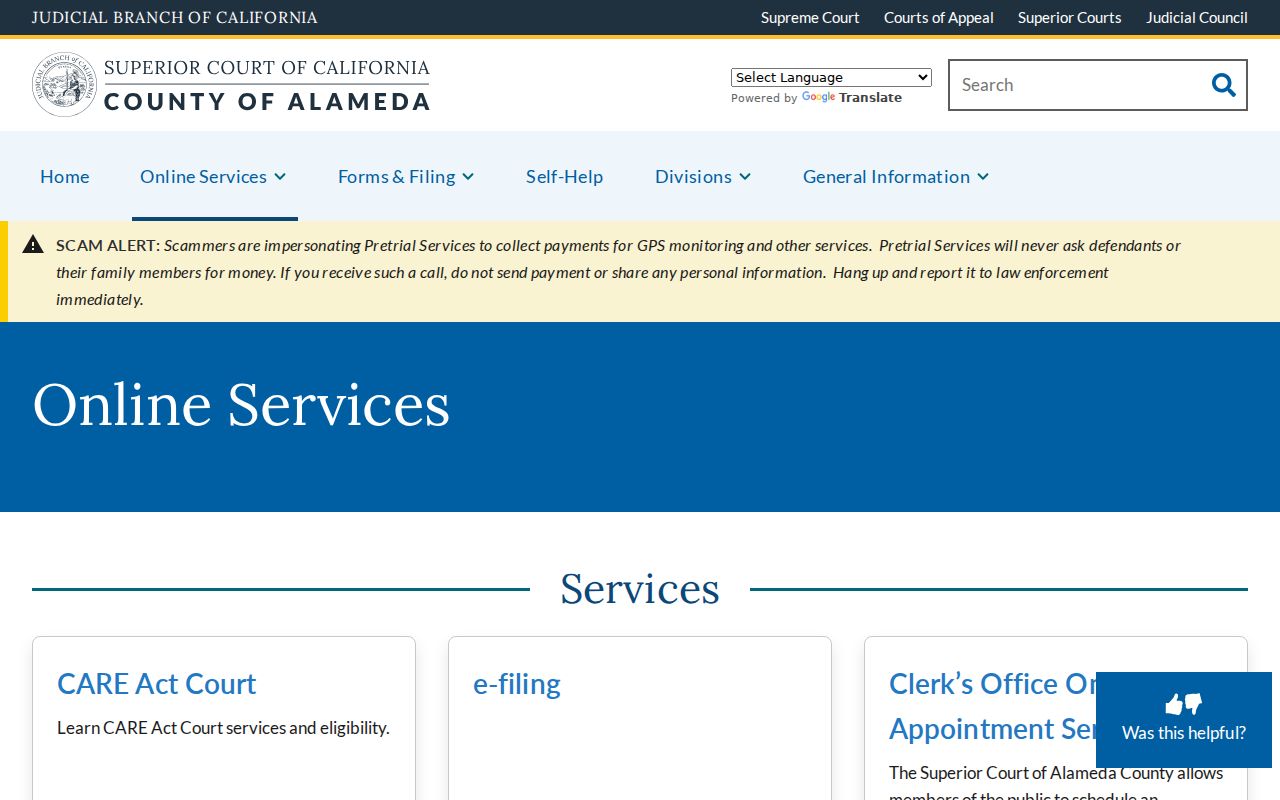
Remote access is limited by California Rule of Court 2.503. Sensitive family, juvenile, adoption, guardianship, mental-health, criminal, protection, and sealed material may require a courthouse terminal or record request. An uncertified electronic copy is not the official record, and a no-hit result is not proof that no case exists.
Vital events use a separate route. Alameda County issues county certificates; CDPH-Vital Records maintains statewide birth, death, fetal-death, marriage, and divorce records. California offers authorized and informational certified copies. Informational copies cannot establish identity, authorized copies require an eligible requester under Health and Safety Code sections 103526 and 103526.5, and confidential marriage copies are restricted under Family Code section 509.
2026 CDPH fees are birth $31, death $26, public marriage $19, dissolution $18, and fetal death $23. Eligibility controls each order.
California Vital Records registration begins in July 1905. Earlier research needs county certificates, historical indexes, newspapers, cemetery material, or archives. A vital copy confirms an event, not current Dublin residence.
Dublin CPRA Request Paths
The California Public Records Act, Government Code sections 7920.000 through 7931.000, lets any person request identifiable existing records. Identify the agency, series, Dublin address or APN, department, date range, and desired format. Name any plans, attachments, maps, or inspections.
The Dublin public-records request gateway routes municipal requests through NextRequest. Laserfiche WebLink may already hold legislation, agendas, minutes, resolutions, and disclosures. County deeds, court files, certificates, and voter information use their own custodians.
The agency generally makes a determination within 10 calendar days. An unusual-circumstances extension can add no more than 14 days. Ten days is not a production promise. Inspection is free during office hours, duplication reflects direct cost, and CPRA does not require creation of a resident list or answer to an open-ended question.
The Dublin public-records request gateway gives a practical view of the municipal starting point.
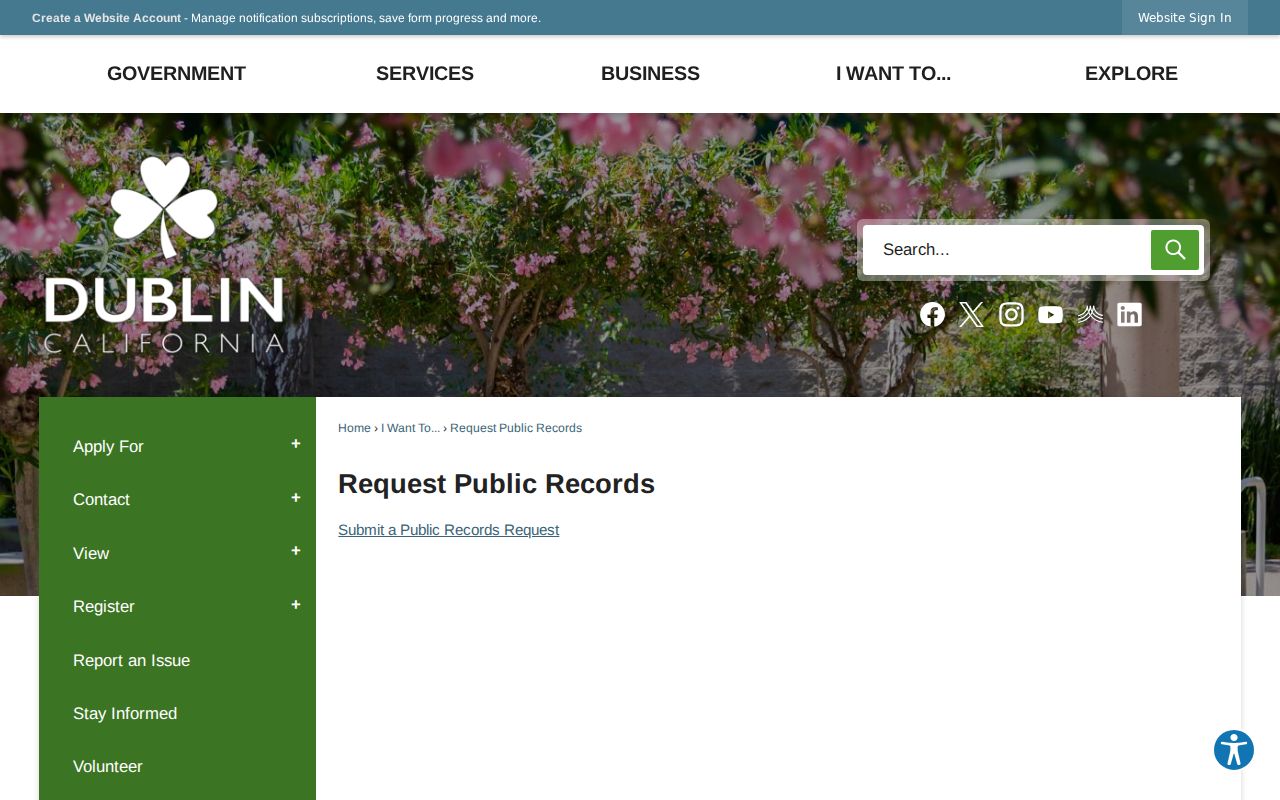
A focused request can ask for an electronic record, held spreadsheet, permit file, address-assignment document, or named disclosure. Privacy exemptions, law-enforcement rules, and court access rules still apply.
Note: A CPRA determination deadline measures the agency's access response, not the date when a complete production must arrive.
Dublin Records Privacy Limits
Some Dublin resident records are absent because the law protects people. Safe at Home can provide a substitute mailing address and confidential voter registration. Voter files, sensitive court records, DMV information, and sealed or redacted files have their own boundaries.
When a result is wrong, use the custodian’s correction, sealing, redaction, or copy process. When a record ends, choose a lawful source that answers a different question, such as an obituary, probate file, or cemetery memorial. Do not fill a protected gap with unrelated personal details.
Lawful personal use. Dublin records are for legitimate personal, historical, civic, and safety research. California Penal Code section 646.9, Civil Code section 1708.7, and Code of Civil Procedure section 527.6 address stalking, harassment, and restraining-order remedies. Do not use a name, address, record, or image to stalk, harass, intimidate, or harm another person.
A respectful search keeps source links, dates, and record roles together, verifies important facts with the custodian, and stops when the next step would defeat confidentiality.
Note: One public field never cancels another record series' privacy rule, access limit, or requirement to verify with its custodian.