
Trace a Dublin Street by Address
An address starts the search, not a resident verdict. Dublin chain is address -> APN -> GIS -> situs/mailing comparison -> controlled Assessor owner channel -> recorder chain -> permits -> Haines/census. Each step answers a different question. Property Search returns an APN; owner names are omitted online. GIS shows parcels. The recorder names instrument parties. CSS shows applications and inspections. Haines and census place earlier people at an address, subject to coverage. Save APN, address, date, source.
- Enter the standardized address in the Alameda Property Search or tax autocomplete, select the suggestion, and save the APN.
- Open the Dublin GIS viewer; search address or APN and enable Parcels and Address Grid.
- Compare SitusAddress, MailingAddress, and latest document fields. HOEX is only an owner-occupancy clue.
- Use controlled Assessor channels for the owner name; the web layer omits it.
- Search the owner or latest instrument in the recorder index; save role, date, type, number, and legal description.
- Search Dublin permits, plans, licenses, inspections, and address files; keep roles separate.
- Check Haines runs and pair them with census, deeds, phones, voter material, obituaries, or newspapers.
Dublin's Address-Keyed Record Trail
A Dublin address record trail joins address-keyed sources, but each answers a different question. The street locates the parcel; the APN carries it into assessment, deeds, permits, and maps. An owner, deed party, permit applicant, and voter are distinct roles.
| Address record source | Address key | What the street view can show | Access boundary |
|---|---|---|---|
| Alameda Property Search | Standardized address or APN | Assessment facts, situs, values, use, transfer clues | Free online search; owner omitted |
| Dublin GIS parcel layer | Address, APN, geometry | Adjacent polygons, situs/mailing, building and latest-document fields | Public dynamic map; non-survey |
| Assessment roll and tax bill | APN or property address | Owner via controlled channels, mailing destination, values, exemptions | Counter or limited phone/email; some files confidential |
| Recorded documents | Party, instrument, date, or type | Deeds, liens, easements, maps, parties, legal description | 1969-present index; no address/APN; images office-only |
| CSS permits and address files | Address, APN, tract, or project | Applications, plans, inspections, assignments, project roles | Current CSS; legacy files through City records |
| Haines criss-cross directories | Historical street address | Listed person or business at a covered address | 1973-82 and 1984-2019; Oakland History Center |
Sources remain separate. The APN links assessment to GIS and helps target deeds or permits. The city-approved situs ties the lot to a street number; mailing may point away. The recorder reveals a transfer, not occupancy. Label each result by what it proves.
Dublin Property Search Starts the Address Chain
The Alameda County Assessor property search is the first pass from a Dublin address to an APN. Address and Parcel Number tabs use autocomplete; select a standardized suggestion.
The Alameda property-search source shows the address controls.
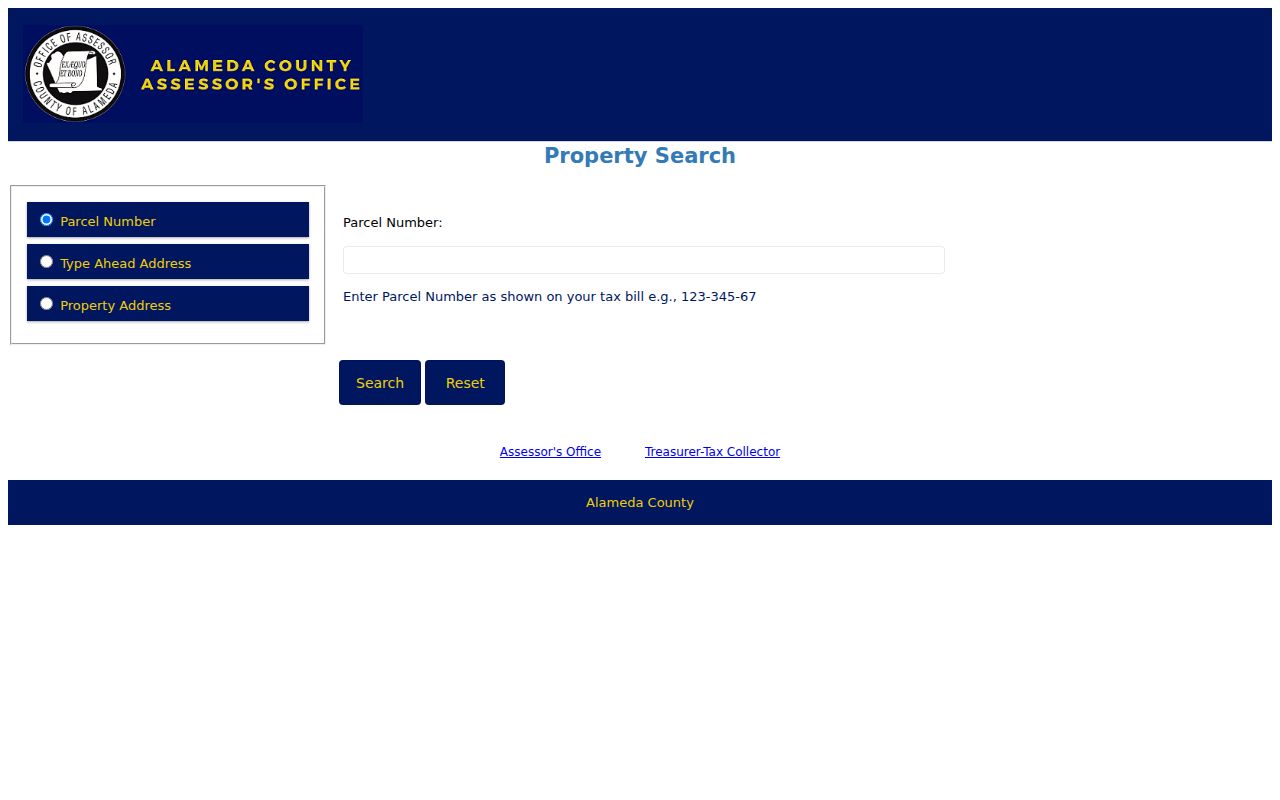
Result is a parcel lead, not an online owner roster. APNs use dashes and no leading zeroes, such as 123-345-67. Preserve the value exactly. The portal exposes assessment facts, maps, exemptions, use code, and transfer clues; owner names are omitted online.
| Search field | Control | Required | Format or use |
|---|---|---|---|
| Parcel Number | Radio plus text | One mode | Enter an APN such as 123-345-67 |
| Type Ahead Address / Property Address | Radio plus autocomplete | One mode | Select the standardized suggestion |
| Search | Button | Action | Execute the chosen search |
| Reset | Button | Action | Clear the current search |
Note: An APN is a parcel key for research; it is not a name, a legal description, or proof that a person lives there.
Browse a Dublin Street in GIS
The Dublin parcel service makes the street spatial. It searches addresses, parcels, schools, parks, streets, and other features. Themes include Default, Address Grid, Benchmarks, Garbage Collection, Land Use, Street Sweeping, and Zoning. Allow pop-ups, map-browse the street, and click adjacent polygons.
The Dublin GIS parcel layer is the map evidence behind the address trail.
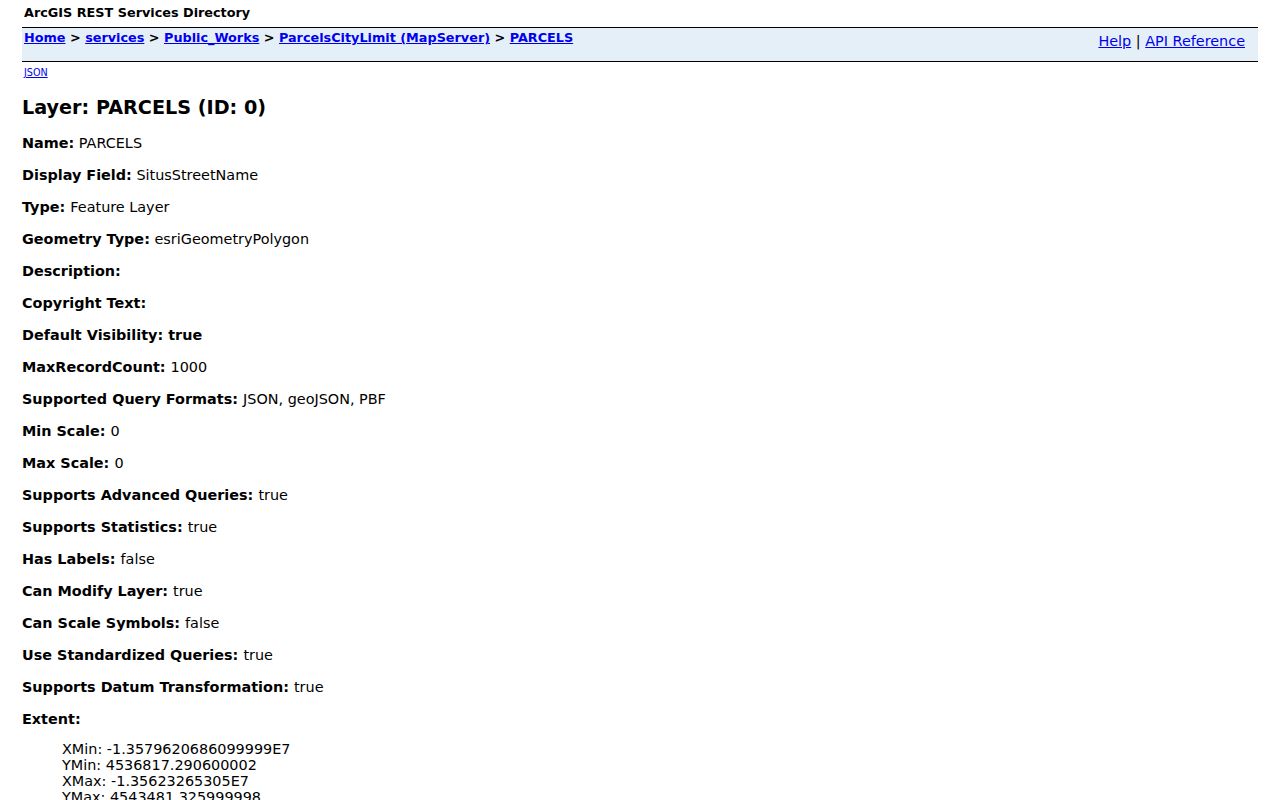
A parcel report can show APN, book, page, parcel and subparcel; latest document identifiers; situs and mailing address with ZIP+4; values, exemptions, use and class; year built, effective year, building, lot, room, bed, bath, unit, acreage, additions, and selected features. The REST service supports spatial and distance queries, pagination, and export to 1,000 features; the interface supports export, print, and share. It is not a legal survey or household roll.
Dublin Situs, Mailing, Owner and Occupant
Four address ideas sit beside one parcel. Situs is the mapped location. Mailing is where assessment correspondence goes. Owner comes from the controlled Assessor channel. Occupant is separate; none alone proves who lives there. An off-site mailing address is a lead, not proof of vacancy or absence.
HOEX can support an owner-occupancy inference but does not name a household. A latest document shows a transaction, not an occupant. Keep situs and mailing strings together, and carry the APN forward.
Address terms
- Parcel
- A mapped property unit identified by an APN. It is a land and assessment key, not a list of people.
- Situs address
- The address attached to the parcel's mapped location in the GIS and assessment data.
- Plat
- A recorded or approved map used to show parcels, streets, or easements. Dublin files include final and parcel maps.
- Criss-cross directory
- An address-first directory that can associate a covered street address with a listed person or business.
Assessor Channels for Dublin Owner Names
The online property layer omits ownership. For limited parcels, the Alameda County Assessor documents owner lookup by phone at 510-272-3787 with an address or APN. The office also lists AssessorWebResponse@acgov.org and accepts written requests. A controlled channel helps protect officials' addresses from an open web search.
Phone and email
Give a Dublin address or APN for ownership inquiry.
510-272-3787
AssessorWebResponse@acgov.org
Oakland kiosk
Kiosk access is available at 1221 Oak St., Room 145, Oakland.
Monday-Friday, 9:00-4:30
Dublin satellite
Assessor service is also available at 7600 Dublin Blvd., Suite 270.
Kiosk fields include APN, owner name, property address, land, building, fixture or business values, exemptions, total assessed value, tax-rate area, use code, and parcel maps. The prior-two-year transfer list can offer a transfer-tax clue, not assessed value. Ownership statements, exemption claims, preliminary change forms, construction-cost or income material, and assessor comparables have separate confidentiality limits.
Recorder Limits on a Dublin Street
The Alameda County recorded-document search is a party and instrument index, not a street browser. It can name a grantor, grantee, lender, trustee, or lien claimant, but accepts no address or APN. Results show Instrument Number or Book/Page, Date Filed, Document Type, indexed and associated names, party-role or index-status codes, and row or page counts.
The recorded-document index view shows why an address search must pivot through the owner or an instrument.
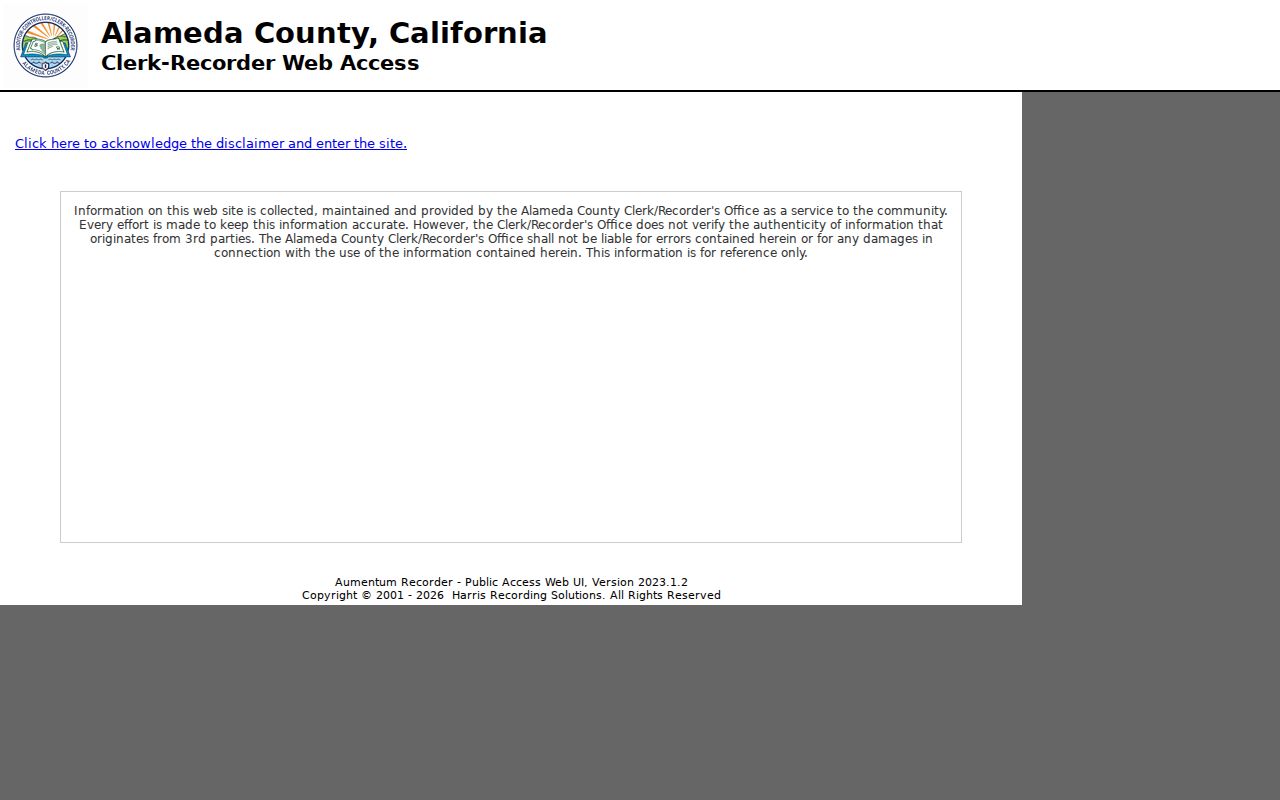
Alameda recorded documents reach from 1853 to the present; electronic indexing begins in 1969. Records from 1853 through 1968 require an in-person search at 1106 Madison Street in Oakland. Images are office-only under Government Code section 7928.215. The index is free. Plain copies are $3.50 per page; certified copies are $4.50 for the first page and $3.50 for each additional page. Online orders use card; mail requests need instrument, book-page or reel-image details, a U.S. check or money order, and a self-addressed stamped envelope. In-person service accepts cash, debit or ATM, check, or money order. Mail generally takes 5-10 business days; a new filing may need two weeks.
To move backward, obtain the current owner or latest instrument through the Assessor, search that name or instrument, and inspect the deed. A grantor transfers an interest; a grantee receives it. Search the grantor as an earlier grantee, then compare legal description and APN. Namesakes make legal description more reliable than a name alone.
Note: The recorder index can point to an instrument, but the index alone does not show the deed image or current occupant.
Dublin Permits and Address Assignments
The Dublin Citizen Self-Service portal is the current entry point for building and public-works permits, planning applications, fire permits, and business licenses.
The Dublin CSS permit search marks the current municipal system used for address-based project research.
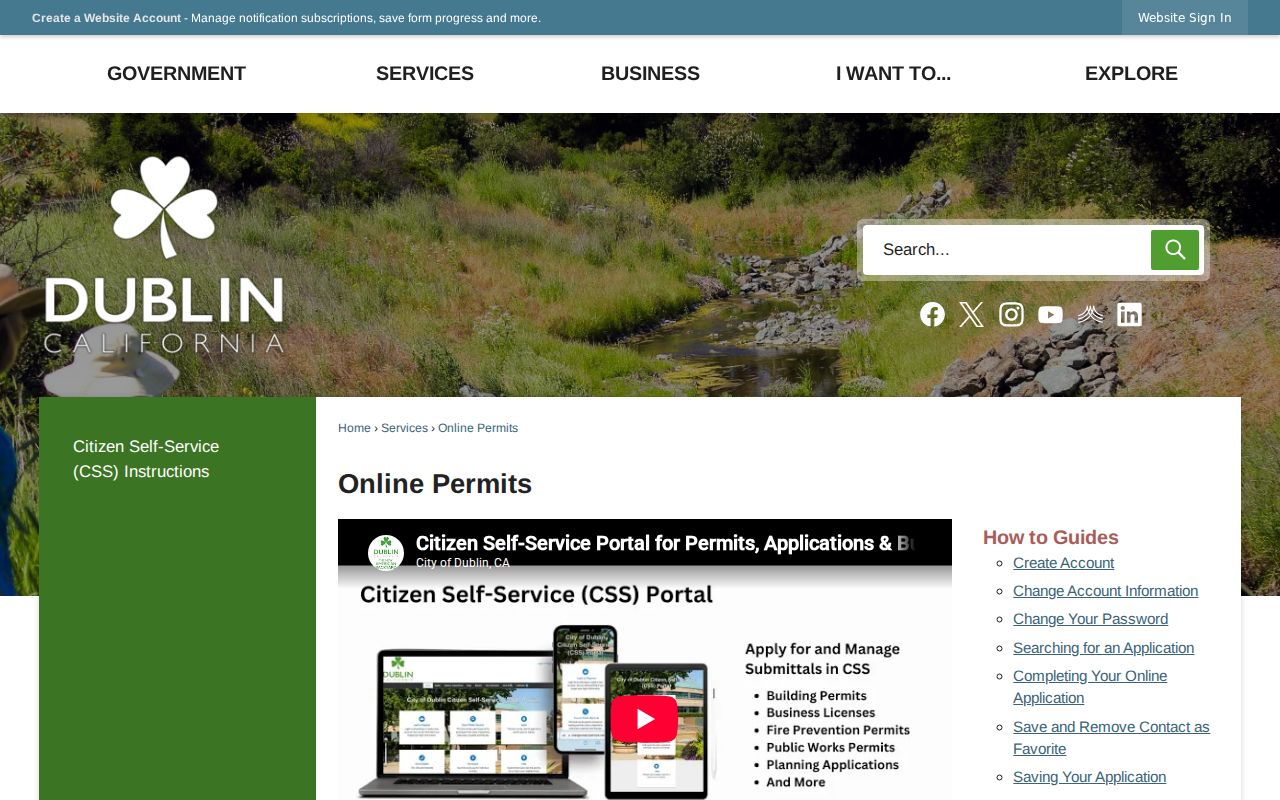
CSS launched July 5, 2024. Actions include submitting, paying, tracking, scheduling inspections, viewing results and approvals, and exchanging documents. Records group under Permits, Plans, and Licenses, with an All option; some management requires an account. A no-result does not settle an older address question. Send a focused request through the Dublin public-records request channel for legacy files, naming address or APN, record type, department, date range, and format.
Dublin Public Works records include amended maps, certificates of correction or compliance, grants of deed or easement, mergers, parcel-map waivers, single-parcel review, final or parcel maps, warranty closeout, and street vacation or abandonment files. They can connect an APN to a developer, applicant, contractor, or project, but a project contact is not automatic evidence of residence.
Under Dublin Municipal Code section 7.08, an address application can request an APN or tract, proposed address, reason, type, plans, north arrow, entries, and grid or floor or unit details. The Dublin address application form asks for applicant and developer contacts plus ownership or applicant certification. Approval is not guaranteed.
Haines Directories for Dublin Streets
For address-first work in the suburban era, the Haines East Bay and Southern Alameda criss-cross collection is more useful than a rural name list. Runs cover 1973-82 and 1984-2019, with the Oakland History Center holding them for in-person use. The 1983 gap is part of the search plan. Check each volume's Dublin coverage before treating a missing address as a missing household.
A Haines entry needs a second source. Pair it with the newest open federal census, 1950, then bridge 1950-73 with phones, deeds, voter material under its legal limits, obituaries, newspapers, or permits. Keep old street forms, initials, and place names as variants. A Haines hit is historical address evidence, not proof of a current Dublin occupant.
When a street search shifts to one person, the Dublin resident lookup adds case, vital, business, and license checks. Historical shelf is in the Dublin city directory collections; Haines stays an address tool.
Before Dublin Had City Files
Older street searches cross a boundary that a modern address can hide. Dublin incorporated on February 1, 1982, after voters approved incorporation in 1981, with an initial area of 3.54 square miles. Camp Parks was annexed in 1986. Western additions brought the city to 8.46 square miles by 1991, and an eastern annexation began major growth in 1995. By 2010, the city covered about 14.62 square miles. Files from before incorporation may sit with Alameda County rather than Dublin municipal custodians.
Use Dublin with Dougherty's Station, Murray Township, Rancho San Ramon, and older family names when a street's modern label fails. The dedicated ZIP 94568 dates to 1982, but postal, planning, county, federal, and incorporated-city lines do not always match. Deeds, subdivision maps, corrections, mergers, street vacations, address assignments, Haines volumes, census schedules, and permits are better bridges than a guessed renumbering story.
Note: No verified blanket Dublin street-renumbering year or authoritative online Sanborn run was found in the local research.
Dublin Voter Data Is Not a Street Roll
California My Voter Status and Alameda My Voter Profile are authenticated self-lookups. A voter enters first name, last name, date of birth, and the form's sensitive identifier. A match can return registration status, party preference, vote-by-mail status, polling place, and election information. It is not a public by-name list for Dublin.
| Voter route | What it can confirm | Boundary for street research |
|---|---|---|
| My Voter Status | An individual's own registration status, party preference, vote-by-mail status, polling place, and election information | Self-check only; it does not return a public street list |
| Controlled voter file | Qualified-purpose data may include names, residence or mailing addresses, precinct, status dates, method, and participation history | Election, scholarly, journalistic, political, governmental, or record-review purpose required |
Elections Code section 2194 and Government Code section 7924.000 keep voter information outside ordinary CPRA access and restrict its use. A request for voters living on a certain street in a certain city is not a specific-voter request. Protected voters and sensitive identifiers remain confidential. Neighborhood Watch is a separate voluntary layer: Dublin helps residents locate a Block Contact through Crime Prevention at 925-833-6686, but the City does not publish household rosters.
Limits of a Dublin Street Directory
No official Dublin or Alameda tool supplies a complete list of household members, utility customers, DMV address holders, or present occupants. An Assessor owner may be an individual, trust, or entity. A mailing address may be off-site; a permit may name an applicant or contractor; a deed may name a lender or trustee. Each clue has a narrower meaning than a claim about who lives there today.
California's public-records law does not require an office to create a new resident directory. A focused CPRA request can identify existing nonexempt Dublin records by address or APN, department, record type, date range, and desired electronic format. The custodian can apply privacy exemptions and record-specific rules. Use the Assessor, Clerk-Recorder, GIS, City, court, or election channel that actually holds the record rather than asking one office to answer every street question.
Lawful use. Dublin address and parcel records support personal, lawful research such as property history, family history, genealogy, and civic record review. Do not use them to stalk, harass, intimidate, or harm anyone. California stalking and civil-harassment laws still apply when information came from a public record.